

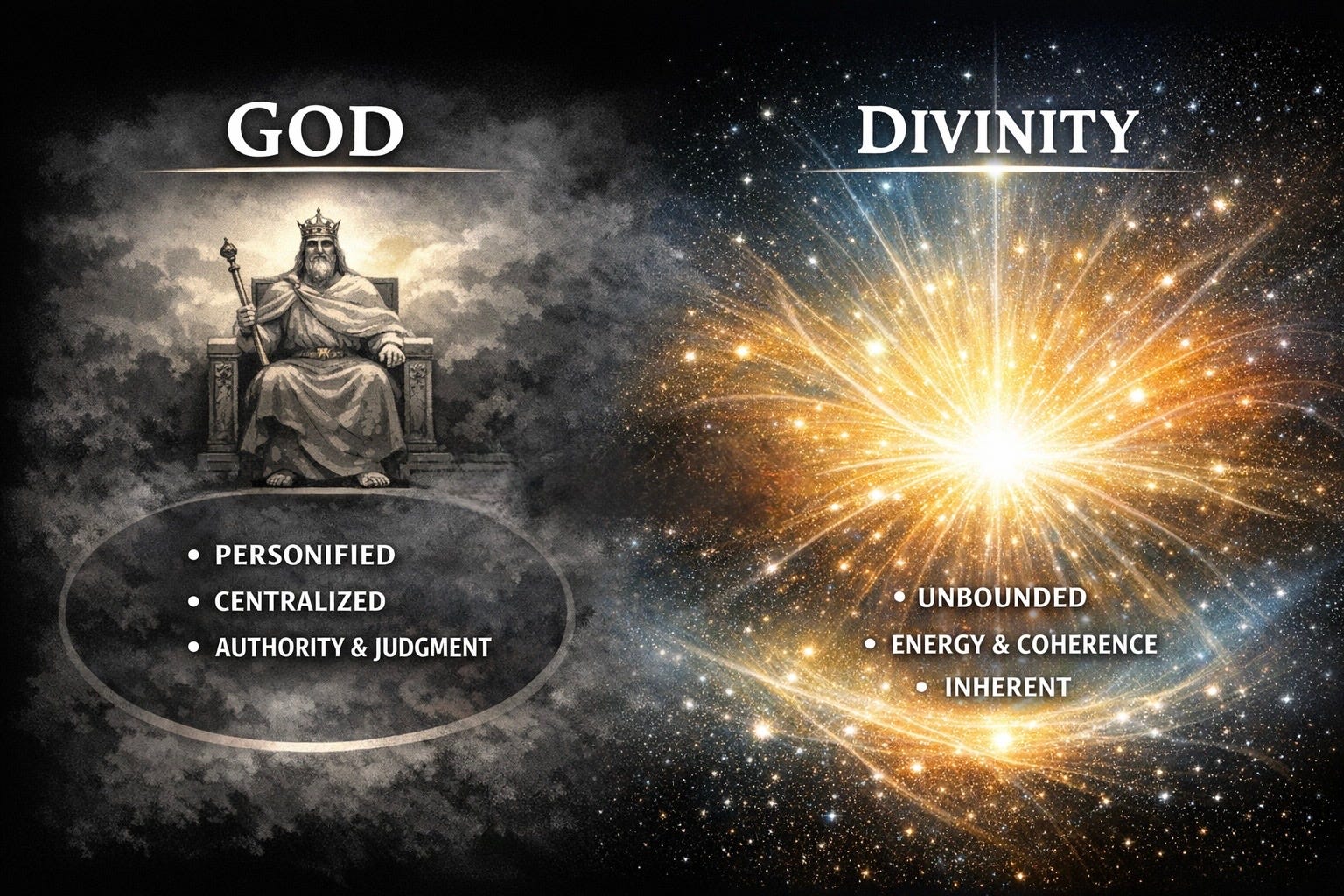
We have a linguistic problem that has quietly grown into a spiritual crisis. We use the words “God” and “divinity” as though they refer to the same reality, as though they are interchangeable terms pointing to a single truth. They are not. Treating them as synonymous has distorted how we understand agency, responsibility, and what it means to exist as a conscious being.
This distinction is not merely semantic. It marks the difference between dependency and maturity, between submission and authorship.
My work is grounded in a simple but destabilizing premise: gods are created by human beings, while divinity is inherent in all beings. When these two are collapsed into one, we begin outsourcing our own agency to figures we ourselves have imagined, then forgetting that we were the ones who imagined them.
A god is a cultural artifact. It is a noun, a figure shaped through language, narrative, fear, aspiration, and social need. Gods reflect the psychological and political landscapes of the people who create them, which is why they vary so dramatically across geography and history. Different eras produce different gods because each era externalizes what it cannot or will not carry internally.
Divinity operates differently. It is not constructed and does not require belief to exist. It is not a personality, a will, or a moral authority. Divinity is the animating intelligence and generative capacity that allows life, awareness, and expression to arise at all. It is a property of being, not an object of worship.
A simple analogy makes this clear. Divinity is the electricity, always present, always operative. God is the localized power company we invented to regulate it, meter it, and charge us for access.
This distinction is not new, nor is it heretical in the way it is often framed. It appears plainly in the very texts many claim to defend. Isaiah 44 describes a man who cuts down a tree. With one portion of the wood, he builds a fire, cooks his food, and warms his hands. With the remaining portion, he carves a figure, bows down to it, and prays, “Deliver me, for you are my god.”
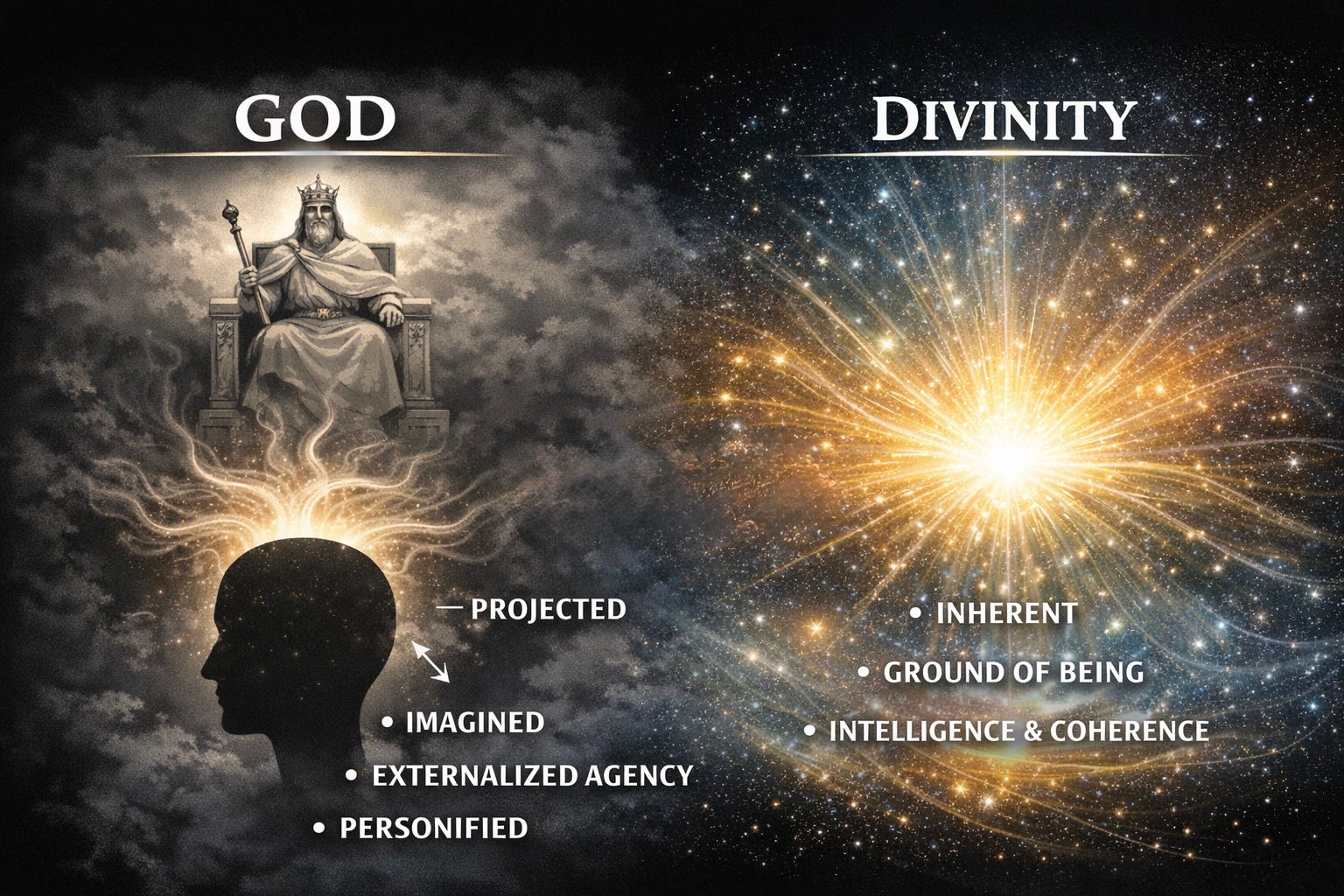
The prophet does not describe revelation. He describes fabrication. The point is not that the god is metaphysically false, but that the creator has forgotten he is the creator. The same material that sustained the man’s life becomes the object of his submission. He kneels before his own projection.
This pattern reveals something fundamental about human behavior. We build gods because responsibility is heavy. To exist as a conscious being is to carry authorship, for action, for consequence, for creation, for harm, for repair. When that burden becomes intolerable, it is relocated upward into a figure imagined to stand above us. That figure is then assigned will, judgment, and authority, not because those qualities originate there, but because they have been displaced from the human domain.
Listen to this episode with a 7-day free trial
Subscribe to Dr Dorothy to listen to this post and get 7 days of free access to the full post archives.


